Building Production-Ready RAG Pipelines: Lessons from DocuMind
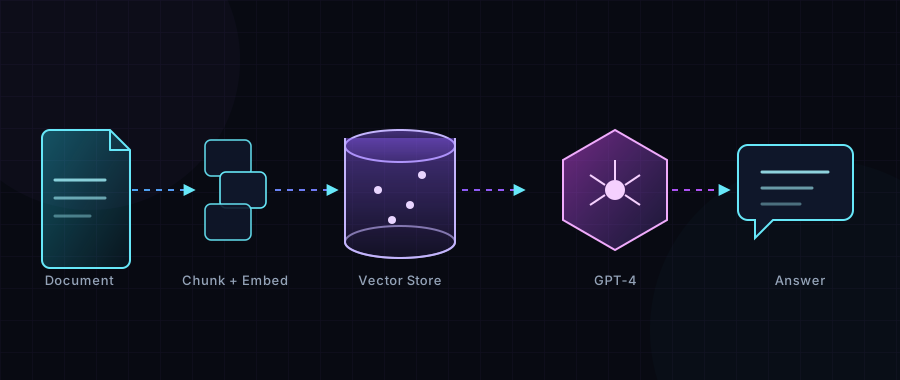
Most RAG tutorials stop at "chunk your PDF, embed it, and ask GPT-4 a question." That gets you a demo. It does not get you a system your team can rely on. Building DocuMind, a multi-document Q&A system, taught me where the real engineering happens.
Chunking is a product decision, not a preprocessing step
The size and overlap of your chunks directly determine answer quality. Too small, and you lose context across paragraph breaks. Too large, and you dilute retrieval precision with irrelevant text. I settled on a semantic-aware splitter that respects section boundaries in PDFs, with a 15% overlap. That one change improved answer relevance more than any prompt tweak I tried.
Conversational memory without corpus re-querying
A naive RAG implementation re-runs the full retrieval pipeline on every turn, including follow-up questions like "what about the second one?" That's slow, and it often loses the plot. Instead, DocuMind keeps a lightweight conversation buffer and only triggers a fresh retrieval when the question meaningfully diverges from the current context. It cut redundant retrievals dramatically while keeping answers coherent across a session.
Latency budgets force real architecture decisions
Getting to sub-2-second responses meant treating latency as a hard constraint from day one:
- Embedding at ingest time, not query time. Documents are chunked and embedded once, stored in FAISS, and never touched again until content changes.
- Streaming responses from FastAPI so the user sees tokens immediately instead of waiting for the full generation.
- Caching frequent queries at the retrieval layer, since enterprise usage patterns cluster heavily around a small set of recurring questions.
What I'd do differently
If I rebuilt DocuMind today, I'd introduce a re-ranking step before the final GPT-4 call: pull the top 20 chunks from FAISS, then re-rank down to the best 4-5 with a cross-encoder. Pure vector similarity is a decent first filter, but it isn't precise enough on its own for dense technical documents.
RAG is deceptively simple to prototype and genuinely hard to productionize. The gap between the two is where the actual engineering work lives.