Bridging Full-Stack Engineering and Generative AI
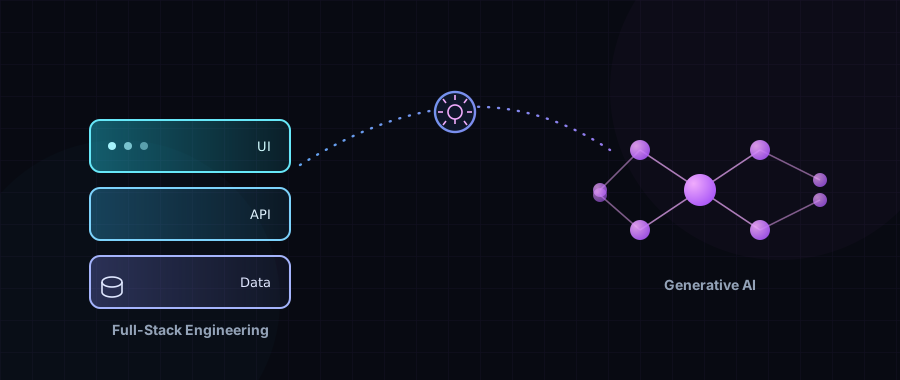
After 9 years building enterprise React, Angular, and .NET systems, I spent the last two years going deep on LLMs: RAG pipelines, agentic systems, fine-tuning. The most useful realization from that shift wasn't a technical one. It was that AI features live or die on the full-stack engineering around them, not just the model.
The model is 20% of the product
A GPT-4 call behind a clever prompt is impressive for about five minutes. What actually makes an AI feature usable in production:
- State management for streaming responses that don't jank the UI.
- Error handling for the very real cases where the model times out, hallucinates, or returns malformed JSON.
- Auth and rate limiting so a single user can't burn your entire OpenAI budget in an afternoon.
- Caching and cost control, because LLM calls are the most expensive line item in most modern SaaS infrastructure bills.
None of this is AI-specific knowledge. It's the same discipline that goes into shipping any reliable web application, just applied to a component that happens to call an LLM instead of a database.
Where the two worlds actually meet
At Mobadrah, I've been integrating LLM-powered features (smart search, auto-generated KPI summaries, natural-language filters) directly into existing enterprise SaaS dashboards built on React and Redux. The interesting engineering problems weren't in the prompt engineering. They were in:
- Deciding when to call the LLM versus falling back to deterministic logic, so the product doesn't feel unpredictable.
- Designing loading and streaming states that make a 2-3 second model response feel instant.
- Keeping the AI feature additive. If the LLM call fails, the dashboard still works exactly as it did before.
Advice for full-stack engineers moving into AI
Don't start by learning transformer architecture. Start by building one end-to-end RAG or agent project and paying attention to everything around the model call: the API layer, the frontend state, the error boundaries, the cost monitoring. That's where your existing full-stack instincts translate directly, and it's also where most "AI features" actually fail in the wild.
The teams shipping durable AI products aren't the ones with the fanciest prompts. They're the ones who treat the LLM as one more service in a system they already know how to build well.